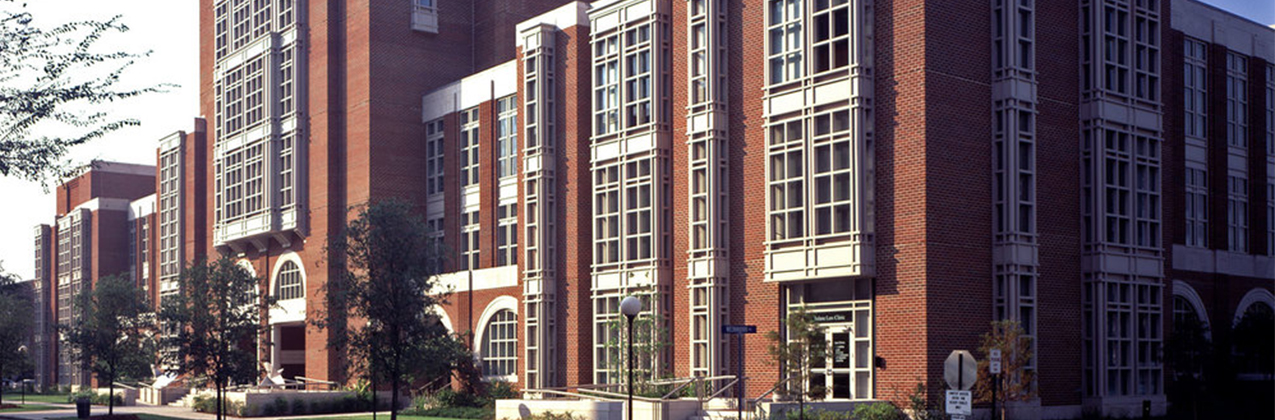


Because of the cumulative nature of the material, and the difficulties involved in providing short term housing, students must enroll for the entire program, even though the electives are divided into two-week sessions. Students may receive credit for both the required course, and up to two courses in each of the two-week sessions, for a maximum of five credits. With the exception of the first two introductory classes, which will meet on Monday, July 5th, and Tuesday, July 6th, classes will meet Monday, Tuesday, Wednesday and Thursday in the Faculty of Law building at the University of Amsterdam, with Field Trips occupying occasional Fridays. During the first session, each class will be one hundred (100) minutes long, and meeting times will be between 9:00 a.m. and 5:00 p.m. During the second session, each class will be ninety (90) minutes long, and meeting times will be between 9:00 am and 4:05 pm. The courses and exams in each session will be scheduled sequentially so as to avoid any conflicts, and exams will be held on Saturday, July 17th (for the first session) and Saturday, July 31st (for the second session). Please note that exams will occupy virtually the entire Saturday at the end of each session. Accordingly, students must not plan to depart before the evening of those days, as examinations may not be rescheduled.
Unfortunately, there is no wheelchair access to any part of the University of Amsterdam.
COURSE SCHEDULE:
INTRODUCTION:
Monday, July 5, 2010: 9:00 a.m. – 11:45; 1:00 p.m. – 2:10 p.m.
Tuesday, July 6, 2010: 9:00 a.m. – 11:45; 1:00 p.m. – 2:10 p.m.
Field Trip to The Hague: Friday, July 9, 2010.
Field Trip in Amsterdam: date to be announced
INTRODUCTORY SESSION
The Principles and Institutions of International Criminal Law
and International Human Rights - Larson
This course, which is mandatory for students from the United States, will provide a framework for all the other courses. It will address such basic matters as the major differences between adversarial and inquisitorial systems of justice, and the differences between common-law systems of justice and civilian systems of justice. In addition, it will introduce students to the roles of the United Nations, the European Union, and the United States in the creation and enforcement of international criminal laws, and laws affecting international human rights. Further, the course will acquaint students with some of the tribunals involved in international criminal law and international human rights, such as the ICC, the ICTY, the ICTR, and the ICJ.
SESSION I
The concept of an international criminal tribunal has existed for hundreds of years, but only a few existed before the twentieth century —— and none endured. This course will look at the history of such tribunals, their successes, and failures. In addition to studying the tribunals held at Nuremberg and Tokyo, following WWII, the course will examine the International Criminal Tribunals for Yugoslavia (ICTY) and Rwanda (ICTR), the so-called hybrid tribunals in Sierra Leone and Cambodia, and the new International Criminal Court, with particular attention to cases currently pending on the dockets of these courts.
International Human Rights - Blakesley
The course will provide an introduction to the foundations of international human rights through an examination of a number of contemporary issues in the field. The class will explore such critical tensions as those between sovereignty and intervention, between claims of universality and assertions of cultural relativism, between civil and political rights and economic, social and cultural rights, and among various approaches to justice for human rights abuses. Discussion will focus on the roles played by various actors, public and private, international and domestic. There will be an emphasis throughout the course on evaluating the effectiveness of international human rights law, methods, and institutions in preventing human rights violations.
International Criminal Law I - Kleffner
This course examines the international legal framework for the suppression of the three so-called ‘core crimes’ of genocide, crimes against humanity and war crimes. It addresses the elements of, and differences between, these three crimes and the general principles applicable to them, such as modes of perpetration and defences. Furthermore, theoretical and practical aspects of suppressing genocide, crimes against humanity and war crimes in domestic criminal courts and tribunals are discussed.
The course schedule is as follows:
| 9:00 AM - 10:40 AM |
Law, War, and Terrorism (1) |
|
10:50 AM – 12:30 PM |
International Criminal Tribunals (1) |
|
1:30 PM – 3:10 PM |
International Human Rights (1) |
|
3:20 PM – 5:00 PM |
International Criminal Law I(1) |
SESSION II
Environmental Human Rights - Houck
This course explores the rapid advance of environmental rights as human rights in national, regional and international forums. Among other subtopics will be environmental cases rising under the European Human Rights Convention, indigenous environmental rights, information and judicial access rights, the reach of US courts to alleged violations abroad under the Alien Tort Claims Act and the doctrine of forum non conveniens, and, in all cases, the competing values of development rights in the developing world. Case histories include UNOCAL in Burma, Shell in Nigeria and Texaco/Chevron in Ecuador.
Gender and International Human Rights - Babcock
This course explores issues of gender through an international human rights and comparative law framework. Topics include an examination of international and regional instruments such as the UN Convention on the Elimination of All Forms of Discrimination Against Women (CEDAW) and the Protocol to the African Charter on Human and Peoples’ Rights on the Rights of Women in Africa. Other areas of study include marriage and family; domestic violence; civil, political, economic, social and cultural rights; harmful traditional practices; sexual violence in times of armed conflict; human trafficking, and sexual orientation.
International Law and the Death Penalty - LeBoeuf
This course will focus on international law and the death penalty from several perspectives. It will examine the relevant multilateral treaties and the jurisprudence interpreting those treaties; it will address the role of foreign governments as well as the advocacy of human rights organizations in the modern history of abolition movements; it will review the efforts of U.S. capital litigators in countries that have retained the death penalty; it will examine the concepts of narrative and counter-narrative in capital cases as a potential method in human rights litigation; it will review recent litigation before the International Court of Justice, the application of international law in U.S. courts, particularly the Vienna Convention on Consular Relations.
Refugees and Stateless Persons: Rights & Remedies - Stapert
War, extreme poverty, famine, oppression, natural disasters…. there are many reasons why people are forced to leave their homes in order to seek safety or better living conditions. This course will examine how people become refugees, their political and legal status, their rights, and the legal remedies available to them, both under international and American law. We will also discuss some possible solutions for the ongoing refugee problem from a human rights perspective.
The course schedule is as follows:
| 9:00 AM - 10:30 AM |
Environmental Human Rights (1) |
|
10:35 AM – 12:05 PM |
Gender and International Human Rights (1) |
|
1:00 PM – 2:30 PM |
International Law and the Death Penalty (1) |
|
2:35 PM – 4:05 PM |
Refugees and Stateless Persons: Rights & Remedies (1) |